Wednesday, July 3, 2013

More on Eastern Whip-poor-wills (including a story of a nest find)


Eastern Whip-poor-will nest, Prescott Peninsula, June 2013 (photo courtesy of Chris Buelow)
As mentioned in a few previous posts I conducted two Eastern Whip Poor Will surveys this year with one covering the Prescott Peninsula and one the area of South Quabbin.  This was the second year of the Prescott survey and the first year of the new South Quabbin route.  I completed these routes in mid to late May and found several birds on each survey.  Chris Buelow from the Massachusetts Natural Heritage and Endangered Species Program recently sent an e-mail to all participants of the various surveys and as part of the end of season wrap up included a photo of a nest he found approximately 1000 feet east of one of my survey points on the south end of the Prescott Peninsula.  This spot has had whip poor wills throughout the time of the Breeding Bird Atlas and was one of the factors in establishing the Prescott survey route.  It is really neat to actually see a photo of a nest of one of the birds I probably heard near the spot.  The nest is really no more than just bare ground with the eggs laid on it.  Below is the story of the find from an e-mail I received from Chris:

"I was actually exploring the steep southern ridge of Mt Ram and flushed the bird while walking along the narrow ridgeline. The bird fluttered up only about 6' high, then flew off to the side only about 15', but out of sight behind a pine sapling. The eggs were right there, on the bare oak leaves, equidistant between a triangle 3 white pine saplings, each about 20' from the other. While walking I was actually thinking about your route out here and was wondering if this open oak forest, really one of the few remaining good examples of this habitat out here that hasn't been invaded by white pine, was the source of your birds. It was pretty wild."
If anyone has any other locations in the area where they have heard whip poor wills please consider contacting Chris (I can provide his contact info if anyone needs it) to potentially set up another survey route so we can keep taps on this declining species and see where they are still hanging on so we can hopefully provide data to those making decisions on how to manage certain areas to keep the birds around. 

More information regarding this species can be found at the Cornell Lab of Ornithology website:  http://www.allaboutbirds.org/guide/Eastern_Whip-poor-will/id

Some of the ‘cool facts’ of the Eastern Whip-poor-will posted on the above mentioned website include the following:

Cool Facts

  • Eastern Whip-poor-wills lay their eggs in phase with the lunar cycle, so that they hatch on average 10 days before a full moon. When the moon is near full, the adults can forage the entire night and capture large quantities of insects to feed to their nestlings.
  • Eastern Whip-poor-will chicks move around as nestlings, making it difficult for predators to rob the nest. The parent may help by shoving a nestling aside with its foot, sometimes sending the young bird tumbling head over heels.
  • The male Eastern Whip-poor-will often will investigate intruders near the nest by hovering in place with his body nearly vertical and his tail spread wide, showing off the broad white tips of the tail feathers.
  • Eastern and Mexican Whip-poor-wills used to be considered one species, simply called the Whip-poor-will. But in 2011 they were split into two species based on differences in mitochondrial and nuclear DNA. Eastern Whip-poor-wills give faster, higher-pitched whip-poor-will calls and have more colorful eggs than their western counterparts.
  • The Eastern Whip-poor-will may locate insects by seeing the bugs’ silhouettes against the sky. Its eyes have a reflective structure behind the retina that is probably an adaptation to low light conditions.
  • The oldest recorded Eastern Whip-poor-will was 4 years old.


Eastern Whip-poor-will, Covey WMA, May 18, 2013 

 I have included a photo of an Eastern Whip-poor-will I took earlier this year at Covey WMA.  I would like to thank Chris again for allowing me to use his photograph of the nest as well as his story of the discovery of the nest.

Even more information on Eastern Whip-poor-wills in the state can be found at the link from the Natural Heritage and Endangered Species Program at:
http://www.mass.gov/eea/docs/dfg/nhesp/species-and-conservation/nhfacts/caprimulgus-vociferus.pdf


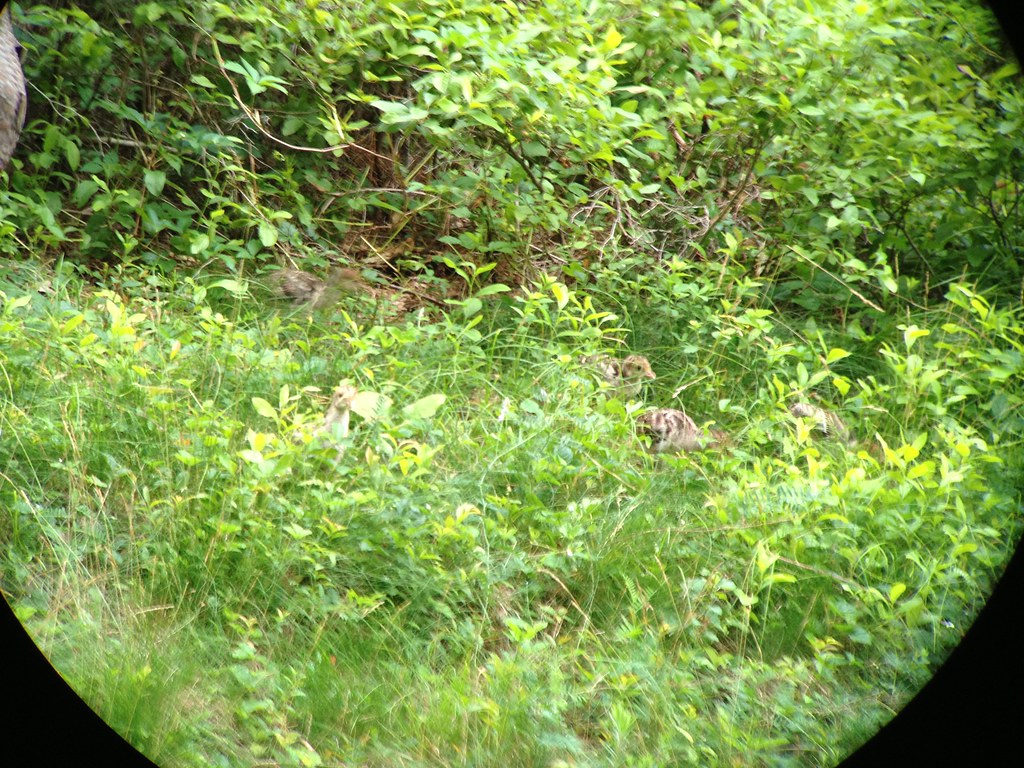
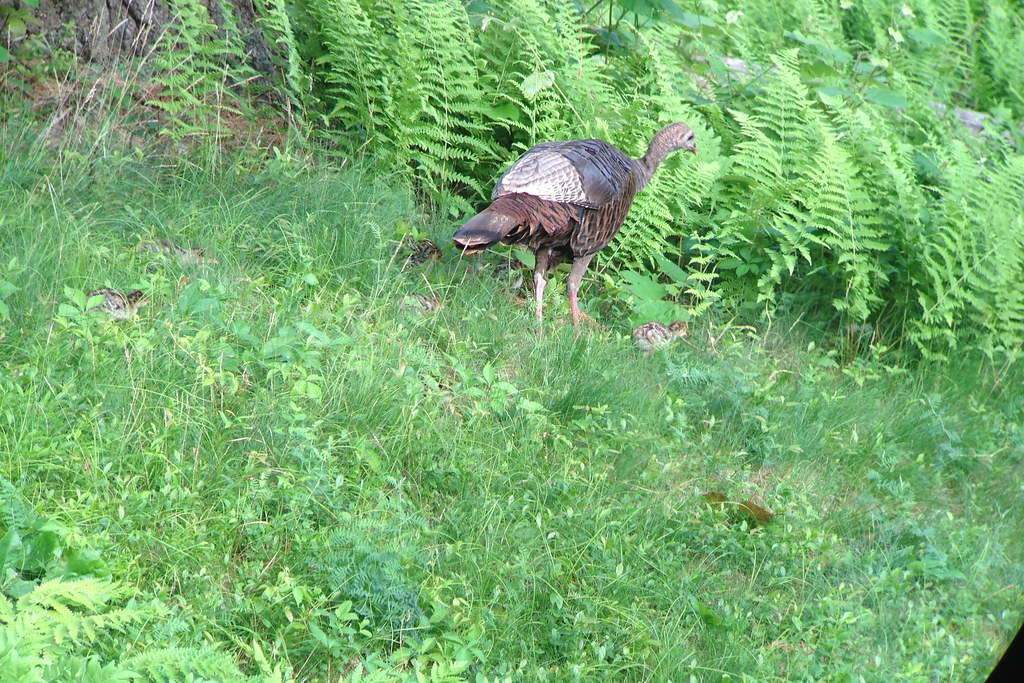
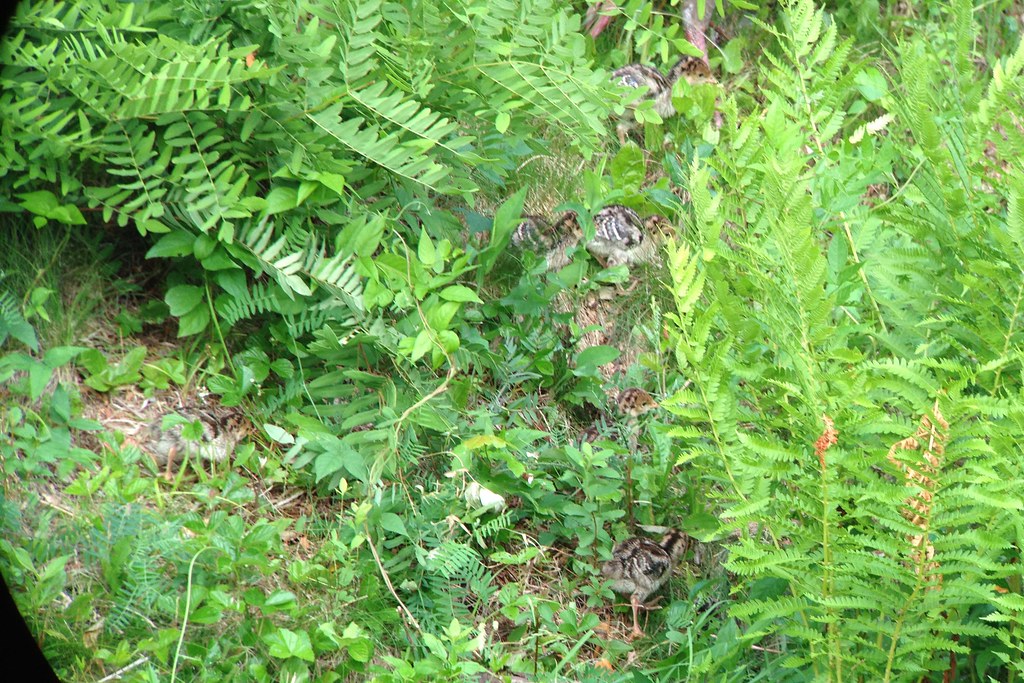
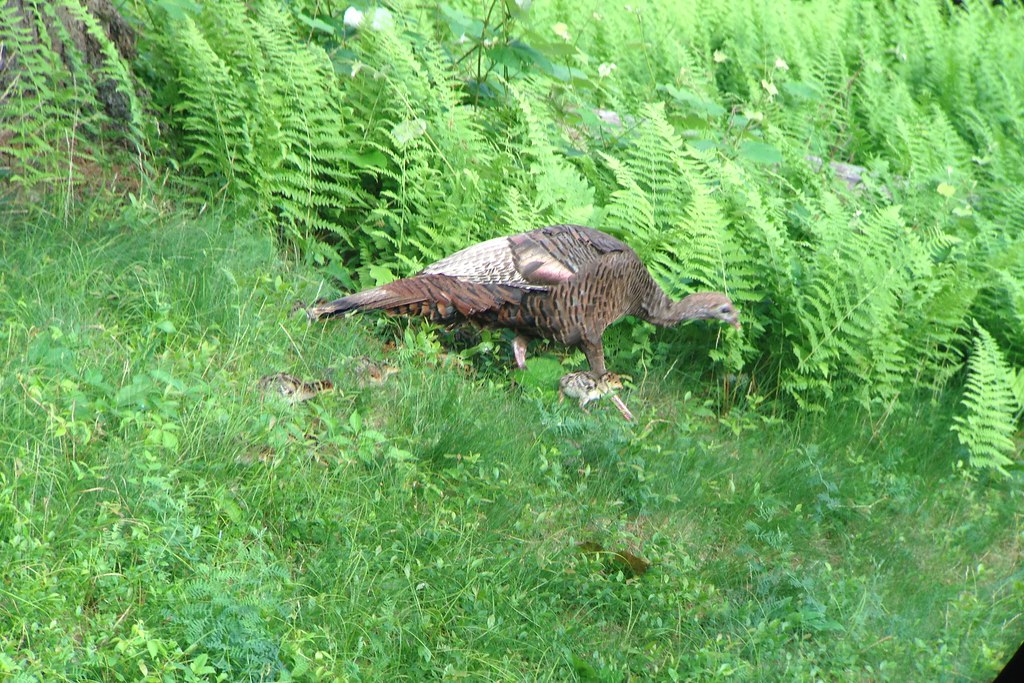
Wild Turkeys, Quabbin Park, MA, July 1, 2013

Wild Turkey, Quabbin Park, MA, July 1, 2013
The last several days have featured more of the same as far as weather is concerned.  The warm, humid tropical conditions have continued.  As an indication of how warm it has been the low temperature last night dipped down to 74!  The next several days will feature even warmer temperatures (90 or above) but with a slightly reduced chances of thunderstorms.  I have gotten out briefly a few times the last few days but the mosquitoes have gotten really bad in a few spots.  I have included a few shots I took with my iPhone through my binoculars of a family of Wild Turkeys at Quabbin Park on July 1.

Sunday, June 30, 2013

Various stops around the local area


Great Blue Heron nest with young, Lake Wallace, Belchertown, MA, June 30, 2013
Got out again at first light before it got too hot and headed over to Covey WMA then briefly to Winsor Dam and finally over to Lake Wallace. The mosquitoes and other biting insects have greatly increased in number and level of annoyance (even with bug spray on). The bird species of the day seemed to be Black billed Cuckoo as I had one calling at home when I got up, a couple more at Covey and another at Lake Wallace. Certainly a good year for them this year. Nothing too exciting at Covey but the swallow numbers continue to grow as most Tree Swallows appear to have fledged. Winsor Dam was very quiet with no birds at all on the water. The eagle nest still held at least one juvenile. Lake Wallace produced around 20 Wood Ducks, a couple Green Herons, an adult and two young at the Great Blue Heron nest and a continuing Sora calling from the marsh. Despite much effort to get a look at the Sora the bird stayed out of view the entire hour I was there but it called on and off the entire time.
Banded Hairstreak, Belchertown, MA, June 30, 2013
At home the diversity of butterflies continues to grow and I had several Banded Hairstreaks chasing each other and occasionally landing plus several other species.

Saturday, June 29, 2013

Lake Wallace, Quabbin Park and home


Great Blue Heron, Lake Wallace, June 29, 2013
Wood Ducks, Lake Wallace, June 29, 2013

On yet another foggy, muggy, warm (71 at 5:15am) morning I headed out to a few local spots to see what I might find. I started at Lake Wallace where I had a calling Sora. Although it called several times and seemed like it was near the edge I never got a look at it as I scanned back and forth with the scope. This is the first one I have ever had here although I have tried to find one on several occasions. It seems like a good spot for breeding of this species. The single Great Blue Heron nest still has two adults nearby but I could not see if a young bird was in the nest or not. A good number of adult and nearly adult size Wood Ducks (26+) and a single Hooded Merganser were the only waterfowl around. 

Barn Swallow, Quabbin Park, June 29, 2013
Winsor Dam near dawn, Quabbin Park, June 29, 2013
Common Mergansers at gate 52, Quabbin Park, June 29, 2013
View from gate 52, Quabbin Park, June 29, 2013
I next headed over to Quabbin Park where I began and ended at Winsor Dam and also visited the route 9 marsh and Gate 52. Nothing too unusual but yet again some nice looks at some birds. Yet again I had a family group of Wild Turkeys along the road near Goodnough Dike with a few less young then several days ago.  A handful of Common Mergansers made up the only waterfowl I could find on the nearly calm waters at Gate 52.

While trying my best to find a tern or something else unusual as I scanned from Winsor Dam I had a Cooper's Hawk flyby with a Barn Swallow in its talons and a large group of Barn and Tree Swallows in pursuit as well as a couple kingbirds adding to the fray. The only waterfowl out on the water at Winsor Dam included 23 Canada Geese, a Mallard, a Common Loon and a couple Double crested Cormorants.
Broad winged Hawk with snake, Belchertown, MA, June 29, 2013
Great crested Flycatcher, Belchertown, MA, June 29, 2013road
Spent the afternoon around the yard with highlights being at least two vocal Broad winged Hawks including one carrying a snake plus an equally vocal family group of Great crested Flycatchers.  Any snake expert out there what to venture a guess at what species of snake the hawk had in its talons? 


Hickory Hairstreak, Belchertown, MA, June 29, 2013
Also had an unusual butterfly sighting in the yard when I had a few hairstreaks chasing each other and one landed and I got photos of it.  According to a few expert butterfliers it is a Hickory Hairstreak...a fairly unusual species and tough to tell apart from a Banded Hairstreak (which is why I asked some people!)

Friday, June 28, 2013

Brief stop at Winsor Dam


Winsor Dam at dawn, June 28, 2013
Our pattern of daily tropical weather with high humidity, warm temperatures and occasional rain and thunderstorms continues.  Overnight several storms moved through with lighting and heavy rain so I decided to try my luck with finding a tern at Winsor Dam this morning (Caspian Tern being the most likely this time of year…two were seen in Worcester county a few days ago).  No luck in finding any terns there this morning.  A gaggle of geese and a lone Double crested Cormorant were the only birds on the water.  A couple of Ring billed Gulls and a handful of Barn Swallows were the only birds out over the water of the reservoir.  Perhaps a tern will show up somewhere else nearby but none were present at Winsor Dam around sunrise this morning.

Monday, June 24, 2013

Quabbin Park and Covey WMA


Wild Turkey with poults, Quabbin Park, June 24, 2013
Wild Turkey poults, Quabbin Park, June 24, 2013
Wild Turkey poult, Quabbin Park, June 24, 2013
Wild Turkey with poults, Quabbin Park, June 24, 2013
Common Loon, Quabbin Park, June 24, 2013
Marsh at Covey WMA (with 'super moon' just over trees on left), Belchertown, MA, June 24, 2013
Marsh at Covey WMA, Belchertown, MA, June 24, 2013
The weather has made a change to summer as we continue to roast in the middle of our second heat wave of the year.  The morning started off cloudy with temperatures around 70 and then quickly turned hazy with temperatures quickly rising up to the low 90's.  With the relatively cooler weather of the morning I headed out just before dawn and hit Covey WMA and Quabbin Park.  Still lots of bird song and lots of birds carrying food or feeding fledglings.  The mosquitoes (and other biting insects) were out in force and were barely kept at bay by insect repellent.  I managed to get a view of the 'super moon' through the haze as the clouds broke briefly at Covey.  I tried to find either bobwhite or pheasant at Covey WMA this morning but no luck.  At Quabbin I had a loon swimming very close to shore at Goodnough as well as a couple of female Common Mergansers that flew repeatedly down the road below the trees calling over and over...perhaps trying to get some young out of their tree cavity?  I also ran across a female turkey with eleven small poults right along the road and managed to get some photos through my binoculars.  Wish I had brought along the good camera but oh well.  The water level at the reservoir is not quite up to 100% but it is getting close and has risen several feet over the last few weeks with all the rain.

Sunday, June 23, 2013

Breeding Bird Survey

Today I conducted my breeding bird survey (BBS) route which starts in Belchertown (BBS Mass route 14)and runs through Ware, Palmer, and Monson to the Connecticut line. The Breeding Bird Survey http://www.pwrc.usgs.gov/BBS/ involves a preset 25 mile route with 3 minutes stops every half mile to census the number and species of birds present.  This year I was joined for almost the entire route by Devin and Aidan Griffiths who provided not only a few other sets of eyes and ears but some great navigation and scribing of what we saw and heard.  The route is much smoother and quicker with other people along.  A 'thank you' to both of them for coming along.

The total number of species for this years route came to 67 species with 818 individuals.  The bird with the best representation overall was American Robin with at least one present at 80% of the stops.  The other top ten (as a percentage) are as follows: Gray Catbird (62%), Chipping Sparrow (46%), Tufted Titmouse (42%), American Crow (38%) House Wren (36%), Black capped Chickadee (36%), Mourning Dove (34%), Cedar Waxwing (30%) and Common Yellowthroat and Northern Cardinal tied at 28%.  The largest overall total of individuals of any one species was American Robin with a total of 86 individuals.

How do the numbers compare to previous years?  The numbers are up from the last couple of years but still below what I got back in 2010.  Last year I totalled 56 species, in 2011 I totalled 64 and in 2010 I totalled 71 species.  The continued 'development' of this route continues with more houses than last year and several outdoor cats roaming the areas.  Not surprisingly the species diversity is quite low where the sprawl exists.  Luckily there are some protected areas along the way that provide for more diversity. 

Saturday, June 22, 2013

Prescott Peninsula

Wild Turkey, Prescott Peninsula, June 22, 2013

Wild Turkey, Prescott Peninsula, June 22, 2013
Tree Swallow, Prescott Peninsula, June 22, 2013
American Goldfinch, Prescott Peninsula, June 22, 2013
Song Sparrow, Prescott Peninsula, June 22, 2013
Gray Catbird, Prescott Peninsula, June 22, 2013

I spent a few hours this morning inside the gates at Prescott Peninsula conducting more work on surveying the bird species in the scattered fields there. I arrived a bit before six and left around nine and covered several of the fields.  I was able to confirm breeding of a few more species that are using the fields here to raise the next generation. Certain species occur in only a few spots (or sometimes in only one) on the entire peninsula and many times the area they are in are one of the fields. In previous years I have had Field Sparrow and Prairie Warbler breeding in the largest field complex but not this year so far. Other speciality species associated with the fields (and edges) include Alder Flycatcher, Yellow Warbler, Blue Winged Warbler, Indigo Bunting and others.  Lots of other breeders around as I travelled from one field to the next but no luck finding any crossbills today.
 
Racing pigeon with leg tag, Prescott Peninsula, June 22, 2013

I did have an odd bird for the area just before I left. I was walking the last section of one of the fields and noticed a turkey and a smaller bird walking in the road. The smaller bird was a pigeon, which is quite unusual on the peninsula. A closer looked revealed it was a racing pigeon of some sort and had a leg tag on its left leg. The leg band was green in color with the code "2013 566rr"...it would be interesting to see where the bird came from.  The bird was nearly oblivious to me and allowed fairly close approach before it flew across a field and perched in a pine. This poor bird will not last long in the open when it exhibits this type of behavior.  The mammals once again put on a good show and I had a Moose and White tailed Deer among others.