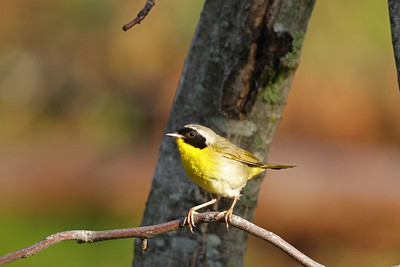
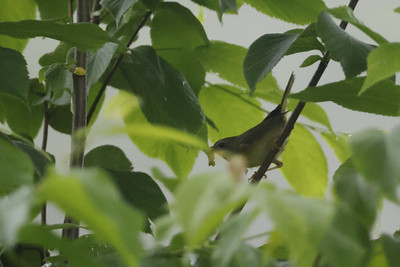
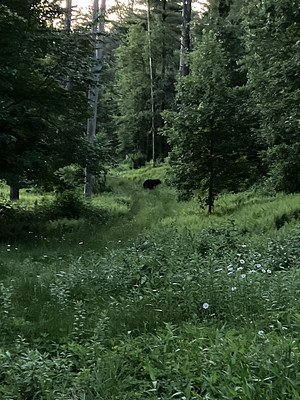
I made another morning trip up to the Prescott Peninsula to conduct more field bird surveys. Today I was joined by four students from Smith College to conduct the surveys and show them the protocols for the surveys. I was running a bit ahead of their arrival so I went it to get a couple quick surveys completed before we met up. As I was headed back to the gate to meet them I ran across a pair of Moose lazily eating from maple leaves. Always fun to see any Moose and two together is even better. Once we all met up we spent about three hours on the peninsula. Although we didn't see any more Moose we did see a Black Bear to add to the large mammal tally for the day. We had some evidence of breeding at multiple stops it was overall slow in adding positive data on breeding. Nonetheless it was a beautiful morning and we had some interesting sightings including at least one flyover Red Crossbill and a family of Ruffed Grouse right along the side of the road.
My observations and sightings in nature from both my local area and much further afield. Focus is always on birds but other parts of nature make it on here too.
Monday, June 8, 2026
Another trip onto the Prescott Peninsula for surveys
Thursday, June 4, 2026
An oddly plumaged bright yellow Scarlet Tanager found while conducting field bird surveys on the Prescott Peninsula
I made it on to the restricted Prescott Peninsula at Quabbin to conduct the first of my field bird surveys for the year. It is part of an ongoing study of the small remaining fragments of farm fields left on the peninsula. On the vast peninsula some of these small fields hold the only populations of a number of species of bird on the peninsula that require more open areas. It was beautiful weather with clear skies, no wind and low humidity. I started my surveys a little before five and then stayed on the peninsula for the next two and half hours completing most of the field locations. The usually most productive and largest field recently had a prescribed burn done. It will be interesting to see the impact (if any) that comes from the burn. Most of the species I would expect to be present were indeed present so no major impact for this year beyond the density of a few species are lower likely due to a reduction in available cover and breeding locations. One of the oddest finds happened while surveying the fields where an old observatory once stood. I saw a yellow bird flying high from tree to another and expected it to be an oriole but instead I saw a bright yellow overall bird with jet black wings...a male Scarlet Tanager with some type of pigment issue. The yellow was not the dull yellow of a fall plumaged bird but instead seemed more like the bright yellow one would see on a Western Tanager. I have seen a few adult male Scarlet Tanager over the years that have a less vibrant red color, to the point of looking more orange. The individual today was unlike any I have ever seen. I poked around a bit to see what I could find regarding the likelihood of this plumage abnormality and did not find much. David Sibley wrote a short article about it...link here: yellow Scarlet Tanager and it is interesting he lives not too far away and his article also mentioned another one in Washington, MA the same year. Perhaps this area of western Massachusetts hosts a population more inclined to have this abnormality? A very cool looking individual and one I hope to relocate on subsequent surveys. I made a couple other stops before heading home to pick up Wilson for his first real post surgery walk and he did well.
Saturday, June 21, 2025
Prescott Peninsula field surveys today
I finally made it up to the Prescott Peninsula to conduct a breeding bird survey within the various remaining fields on the peninsula. I also wanted to follow up on a possible Cerulean Warbler on the lower end of the peninsula as well as see if I could track down any Red Crossbills. I arrived a bit before six and started my surveys. I spent quite a bit of time at the largest field complex and was rewarded with a number of breeding species found at no other location on the peninsula as well as my first flyover Red Crossbills (I would have multiple groups during my morning there but none cooperated enough to get recordings to figure out the Type). One of the best sightings of the day took place while I was there when I had a Bobcat show quite well. I initially saw it for a brief second as I was walking back toward my car and I thought it was a Bobcat. When I walked the few hundred feet up to where I saw it the Bobcat was perhaps a hundred feet away on a grassy side road. It seemed totally unfazed by my presence. It eventually slipped away into the grasses of the fields and out of view. I also ran into Dale and Ki who were out checking on the various game cameras set up on the peninsula. A large tree down forced me to reroute a bit before I was able to make it down to the southern part of the peninsula top follow up on a possible Cerulean Warbler. I had no luck finding a Cerulean Warbler at the location but did have two Black throated Blue Warblers singing a Cerulean Warbler like song so that is likely what was heard. Oddly enough the location is very close to where I had Cerulean Warblers confirmed breeding several years ago during the state Breeding Bird Atlas. I then worked my way back north and surveyed a few other fields before heading back home as the day heated up. Always fun to get out to one of the least travelled places in the state.
Tuesday, July 11, 2023
Prescott Peninsula surveys this morning with a close look at some Black Bears
I took advantage of a rare day this month when I had both the morning off and the weather was sunny. I headed up to the restricted access Prescott Peninsula to conduct a few field bird surveys and hopefully catch up with some of the Red Crossbills that have been steadily moving into the area the last few weeks (more on the crossbills at the following link). I spent almost three hours on the peninsula and checked out a number of fields with some breeding activity present. Bird song is much reduced compared to just a couple weeks ago but there were still birds to be seen and heard. I had a few Red Crossbills flyover calling and got a single bad recording and they turned out to be Type 12 (thanks Tim). The highlights for the morning for me were two Black Bears with one coming in very close as I surveyed the area of the old observatory. I initially saw him walking down the road toward me at quite a distance. He eventually came within perhaps 30 feet of me before he finally veered off into the woods. Always an impressive beast to see out in the wilds of Quabbin!
Sunday, June 25, 2023
Breeding Bird Survey route today
I finally got to conduct my annual breeding bird survey (BBS) route this morning. I typically try to run the survey earlier in the breeding season but this year the weather, work and Wilson made it tough to complete any earlier than today. I possibly could have run it on a weekday earlier but I always try to do it on a Sunday as the traffic is a minimum making birds easier to hear. This marked the 14th year I have conducted the survey (I even did the route when the route was officially cancelled due to Covid). The route starts at 4:42 in the morning in Belchertown and consists of 50 stops of three minutes duration each every half mile (which leaves little to no time to get photos so the ones attached are not the best). The route travels down through Palmer and Monson to the Connecticut state line. The conditions were really good despite some morning overcast as the winds stayed calm and the temps were warm (low for the morning was a balmy 69 degrees). By the end of the route the sun was out and the temps warmed even more. Despite my fear of not having as many species as usual given the later date I ended with a very respectable 77 species. Highlights included a couple of Eastern Whip Poor Wills, a Barred Owl, an American Kestrel, an Eastern Meadowlark, 13 species of warblers and best of all, a new species for me along the route with a flyover Red Crossbill. The Red Crossbill raised the total number of species I have had along the route in the last 14 years to 111. The route has been active since 1967 so this marks the 56th year of the route. Below are the totals for species for each year I have conducted the survey plus the date the survey was conducted.
The ten most abundant species this year are listed in the table below (# of stops species present at)
American Robin 43
Chipping Sparrow 27
Tuesday, June 14, 2022
Eastern Whip Poor Will survey on Prescott Peninsula last night and the morning at Mt Holyoke Range SP
I spent a good portion of the morning exploring the Mt. Holyoke Range SP with the main goals being tracking down any possible Hooded Warblers and checking on the density of Worm eating Warblers. I arrived a bit before six and started walking up toward the ridge. Not long after arriving I was stopped and heard some movement in the woods and I turned around expecting to see a squirrel but instead had a Fisher. I think I was as surprised as the Fisher as we both looked at each other for a few seconds before the Fisher quickly ran away. I had no luck finding any Hooded Warblers as I walked around four miles all the way up to Rattlesnake Knob and then back down to the parking lot in Granby. I had much better luck with Worm eating Warblers with multiple individuals present. I suspect there are a few dozen pairs of this species along the entire ridge. There were also good numbers of other typical forest species as well as great looks at a Porcupine.
Before making my way to Granby I stopped by Lake Wallace again to check out what might be around at dawn (still hoping a Black bellied Whistling Duck will show up some day). Nothing too unusual but good evidence of breeding species.
I made the long drive up to Prescott Peninsula last night to complete my second Eastern Whip Poor Will survey of the season. I was unable to get the route done last year for a variety of reasons so was looking forward to getting up there this year. I checked the route the day before and the road was clear. I arrived at my first stop at the lower end of the peninsula just after sunset and then waited until around quarter of nine to start the route. As I was waiting I heard some branches cracking and looked up to see a large Black Bear ambling past. Unfortunately the light was not great so I could not get any good photos but I got some great looks. I then ran the route as I worked my way north at one mile increments. Unfortunately the numbers were down from previous years with just a single bird at each of the first five out of six stops and then none after that plus a single individual between stops 2 and 3 giving me a total of just six birds. Not sure why the numbers are down but perhaps due to the later date for the survey or maybe some subtle changes in the land. There are some recently logged areas that may be good for the species in the upcoming years so something to look forward to.