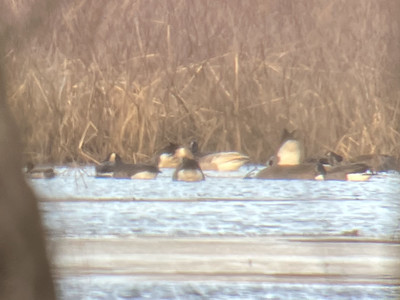
The last three days (especially the last two) have featured well above normal temps with highs in the low 60's today and in the low 70's yesterday which has resulted in lots of snow melt (except in the yard!) and has induced a number of species to move in with waterfowl leading the way. I stayed in the Ware/Belchertown area on Monday and added a couple new species for the year with Rusty Blackbird and American Woodcock. I also got photos of a surviving banded Black capped Chickadee that was banded as an adult in the summer of 2021...a very hardy chickadee when the average life span is 2-3 years! With the major warm up on Tuesday I started my morning at the Holyoke Dam and had ten species of waterfowl including my first Green winged Teal, Red breasted Merganser and Great Black backed Gull for the year in the county. I briefly stopped along the river at Mitch's Way and could hear what sounded like many geese in the East Meadows so I headed there and had to walk in on the muddy and icy farm roads to get a look at the geese enjoying the newly uncovered cornfields. I had a few thousand Canada Geese as well as single Snow Goose plus my first Wilson's Snipe and American Pipits (the Wilson's Snipe became species #100 for the year in the county). With continued warm temps thanks to southerly winds I headed back to the East Meadows before dawn today and once again walked in and could hear geese as I walked as well as a number of Killdeer and at least one Wilson's Snipe and an American Woodcock. I got down past the four corners area and as it became light enough to see I started scanning the fields and turned up tons of Canada Geese, multiple species of ducks and a single Snow Goose. More and more geese began to arrive from every direction and the numbers quickly climbed into the thousands with many stopping the the fields (many dropping out of views in the various flooded swales). I estimated at least 13,700 Canada Geese and I know this is an undercount. I scanned through the flocks over and over, both on the ground and as groups dropped in and I eventually found at least two Cackling Geese (one very pale individual), a single Greater White fronted Goose and two Snow Geese. I tried to find some neck tagged Canada Geese without having any luck. I also had a very early Lesser Yellowlegs fly in and stop for a bit in one of the pools...easily my earliest record for the species and the earliest record ever for western mass (at least in eBird). A four shorebird species day here on March 11th is noteworthy for sure! Other notables included at least 650 Horned Larks, more American Pipits, at least none Fish Crows and a swan that was almost certainly either a Tundra or Trumpeter Swan. As I reached my car to head out just before ten I heard a roaring noise that turned out to be all the geese taking flight...an amazing sight and sound. I also added an Eastern Phoebe at the house in the afternoon. By the end of the day I had reached 105 species for the year in the county.
My observations and sightings in nature from both my local area and much further afield. Focus is always on birds but other parts of nature make it on here too.
Wednesday, March 11, 2026
Warm weather brings in early season migrants and starts melting the tons of snow
Friday, March 7, 2025
Record setting pace for first week of March with 87 species
I typically do not do so many posts here within a few days anymore but I want to make just one more quick post as the first week of March has now come to an end. Despite very windy conditions today I added several new species for the month plus two more for the year in the Hampshire County (new year species being American Woodcock and Gadwall). This was best start to March ever here with 87 species so far (breaking my previous first week of March back in 2022 when I had 77 species). I also stand at 118 species for the year so far in the county which is my highest YTD total for the end of the first week of March. A lot of the good numbers are thanks to a great showing of waterfowl this month with a number of rarities around plus a few early arriving species. For today I started near home and then visited a number of spots along both sides of the river with continued large numbers of geese including a few unusual species (Greater White fronted Geese and Cackling Goose) as well as the Greenland banded Canada Goose. The concentrations of geese continue to be impressive with several thousand Canada Geese in the area with other waterfowl showing also with a total of 20 species so far for the month. The ice on the river is rapidly disappearing and open water is slowly starting to show in other areas.
Tuesday, March 4, 2025
Influx of geese including Pink footed Goose, Cackling Goose, Snow Geese and a uniquely plumaged Canada Goose plus a neck tagged goose from Greenland
With the arrival of March comes the first real pulse of migrant waterfowl and the first few days have been great with geese of various species figuring prominently (plus the continued Trumpeter Swan). I heard of a Pink footed Goose at the Coolidge Bridge on Sunday afternoon but I didn't try for it until Monday on my way to work. Thankfully it was still there and actually showing quite well despite the bitter cold temps. It was one of only a handful of active geese with the rest tucked in most of the time. I also had a Cackling Goose in among the Canada Geese that popped its head up briefly thanks to a pair of very vocal Peregrine Falcons in the area. I then continued on to work and had another extremely busy day (I really cannot wait for retirement!). Very cool how Pink footed Goose has become more common since I found the first county record back in March 2014.
After work on Tuesday I headed out to try to find some more unusual geese with my main target being a pair of Greater White fronted Geese seen at Mount Holyoke College the day before. I got a text from Mary that she tried for them at the location earlier and they were not present so I decided to stop at the open water below the Coolidge Bridge once again. There were several hundred Canada Geese in the water and much more active then the previous morning. A scan through the flock turned up a single Cackling Goose as well as a uniquely plumaged Canada Geese that had a pale body with a typical looking head and neck...cool looking bird. I then decided to head south with the intention of trying to find the Greater White fronted Geese (spoiler alert...I never found them). I stopped off at Mitch's Way with the intention of possibly walking the road (depending on the ice conditions on the road). As I pulled in I saw hundreds of geese in flight so immediately started scanning the birds moving upriver and had a group of nine Snow Geese (with one blue morph) plus a couple other Snow Geese in among the Canada Geese with one looking smaller (possibly a Ross's Goose). I lost track of the small goose but was able to watch the group of nine with views through the scope and binoculars. They never settled down and continued off to the north. I then decided to head back north to check the hordes of geese. I decided to check East Hadley Road and found hundreds of geese with more arriving over the course of the hour I remained on site. Lots of scanning turned up a (the) Pink footed Goose, the pale bodied Canada Goose and a Cackling Goose among 1200+ Canada Geese. I also had one neck banded Canada Goose with a yellow band with black writing with the code "G6Y". I was fairly certain it was a bird from Greenland and a quick email to a researcher up there proved I was right. The bird was banded in Isunngua, West Greenland in July 2023 and was last reported in late November in Nova Scotia (more info on the bird listed at end of post). There were loads of Red winged Blackbirds, Common Grackles, Brown headed Cowbirds and European Starlings as well as a very early Wilson's Snipe that was scared up by some arriving Canada Geese. Although I missed on finding any Greater White fronted Geese I was happy to have a four goose species morning. Spring is certainly starting to show itself, finally.
G6Y (banded Isunngua, West Greenland, July 2023)
27.09.2023 1696 Chemin Saint-Ignace, Saint-Ignace, New Brunswick, Canada 45°29’49”N 62°38’18”W
01.11.2023 Forbes Lake, Pictou County, Nova Scotia, Canada 45°29’49”N 62°38’18”W
11.11.2023 Forbes Lake, Pictou County, Nova Scotia, Canada 45°29’49”N 62°38’18”W
12.12.2023 Avalon Nature Preserve Lake, Stony Brook, New York, USA 40°54’49”N 73°08’46W
28.11.2024 Shaw Pond, Shubenacadie, Nova Scotia, Canada 45°04’56”N 63°24’34”W
04.03.2025 Hadley, Massachusetts, USA
Monday, November 20, 2023
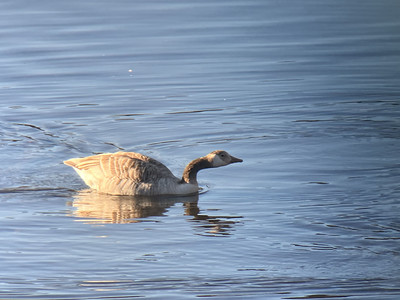
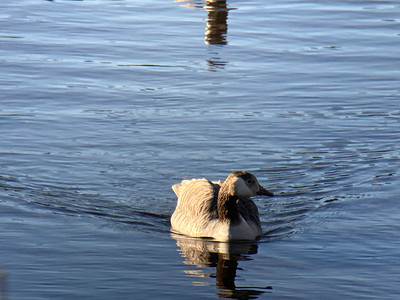
Pale/leucistic Canada Goose returns for a fourth winter
I came across a pale Canada Goose this morning at Paradise Pond at Smith College and I presume it to be the same unique individual returning for the fourth winter to the local area. I first found this bird on January 6th of 2021 at Arcadia and then caught up with it again a week or so later at the UMASS campus pond in a snow storm and it continued in the area through January and then I lost track of it. The following fall it arrived in late November and it stayed around throughout the winter of 2021-2022. It arrived back in the area for the winter of 2022-2023 in late December and stayed until the early part of March. It is now back in the area for the fourth winter season in a row. It really is a neat looking individual and will hopefully stay around. Would love to know where the bird spends its summer.
Here is a sample of some photos I have captured of this individual the last few years at various spots in the valley as it travels around with typical looking Canada Geese.
Although I did not see the Pink footed Geese among the few hundred Canada Geese at Smith College this morning I did find a Cackling Goose that showed fairly well.